Yes or no, a few details, or the whole: three ways to share from your wallet
Why your wallet offers three ways to share, what each one reveals, and how it refuses a verifier that asks for more than it was approved to ask.
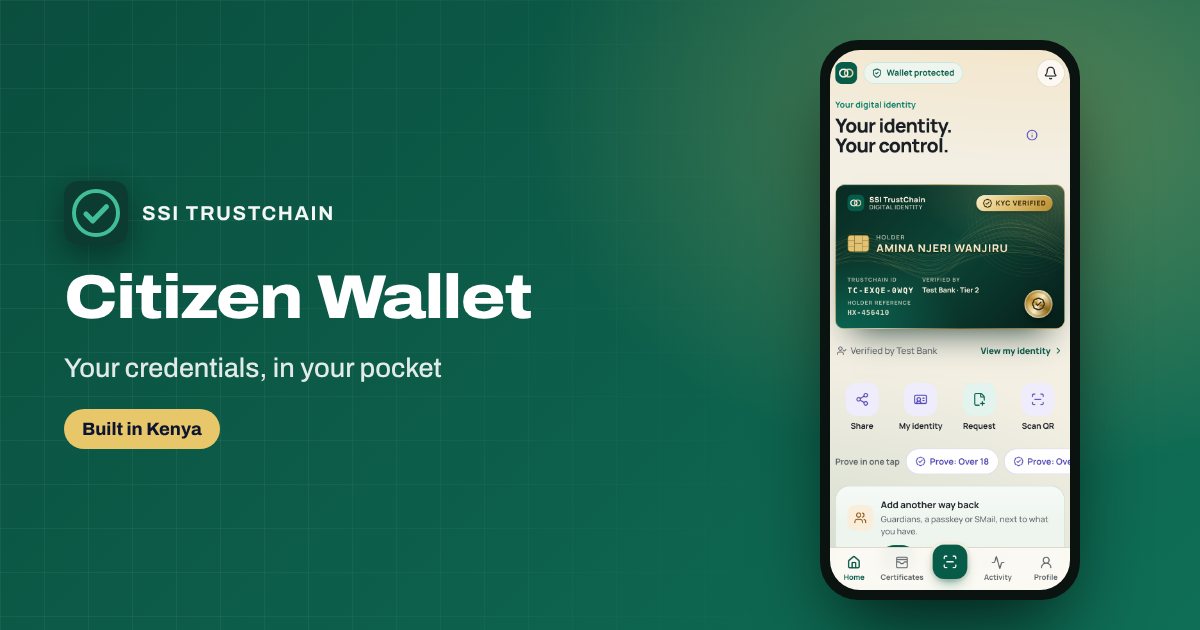
Every time you share from your Citizen Wallet, you choose one of three ways, named the same in every app.
Yes or No (zero-knowledge proof)
The verifier learns one fact and nothing else. A bank asks whether you are over 18; your wallet proves "yes" without your date of birth. A hospital asks whether your licence is valid; it learns "yes" without the licence number.
Selective disclosure
You tick the fields to share, such as your name and the type of degree, and the rest stays on your phone. The verifier sees only what you ticked, checked against the issuer's signature, and the revealed details are deleted 24 hours after the check.
Share as a whole
Sometimes the whole certificate is needed. The wallet says so plainly before you share, and the warning stays on the screen.
Requests that cannot ask for more
Every verifier request carries a registration certificate, signed by TrustChain, that says what that verifier may ask and why. Your wallet checks it before showing you the request, and refuses any request that asks for more.
Unlinkable by design
Each verifier knows your wallet only by its own pseudonym, and every presentation is signed over that verifier's one-time code. Two organisations cannot put your answers together.
And afterwards
Activity lists every share: what was shared, with whom and when. From the same sheet you can ask the verifier to delete it, or go to the Office of the Data Protection Commissioner.