


How TrustChain works
The person holds the data. Institutions hold the signatures. The network holds only the proof that the signatures are real.
The building blocks
Four ideas that make trust portable
An identifier you control
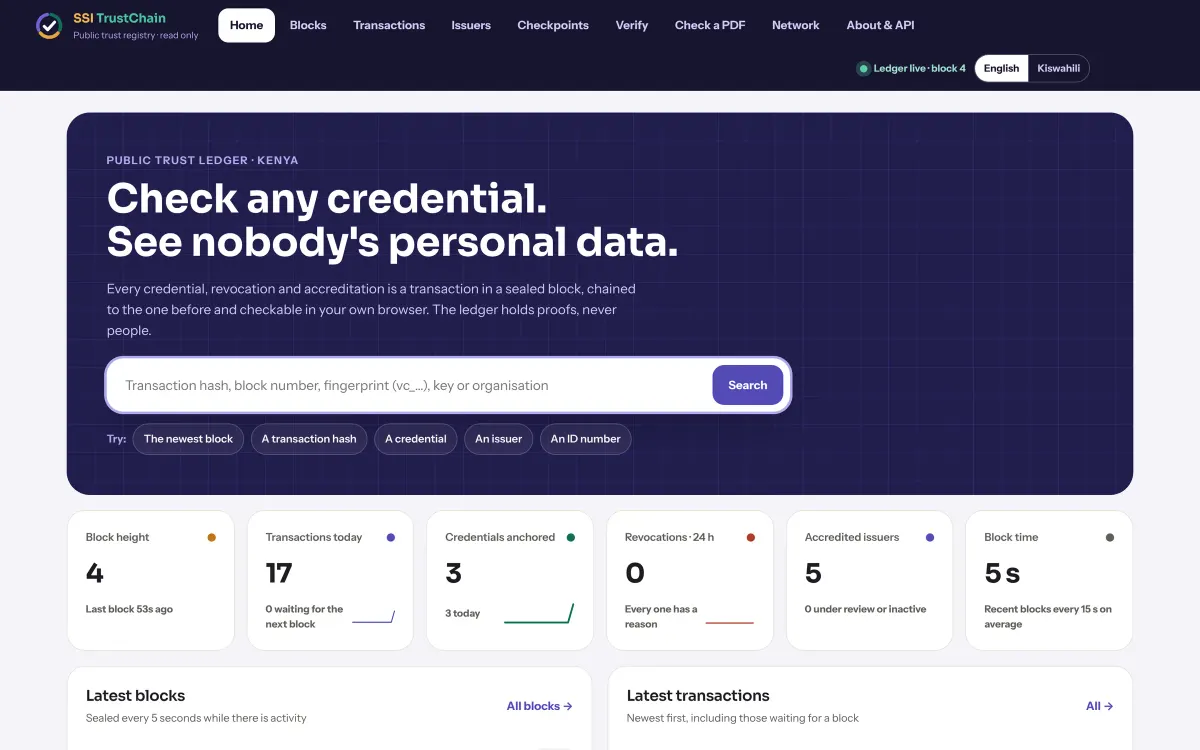
Every person and organisation has a decentralised identifier: a cryptographic identity only its owner controls. No company can take it away or reuse it.
Credentials that cannot be altered
A credential is a statement such as "this person holds a nursing licence", signed by the institution that issued it. Change one letter and the signature no longer matches.
A public registry of who may sign
The registry lists every accredited institution, what it may issue and its signing keys, plus every revocation. Anyone can look it up.
Private proofs
Where a yes or no is enough, the wallet proves it without revealing the data behind it.
Issuing
How a credential is issued
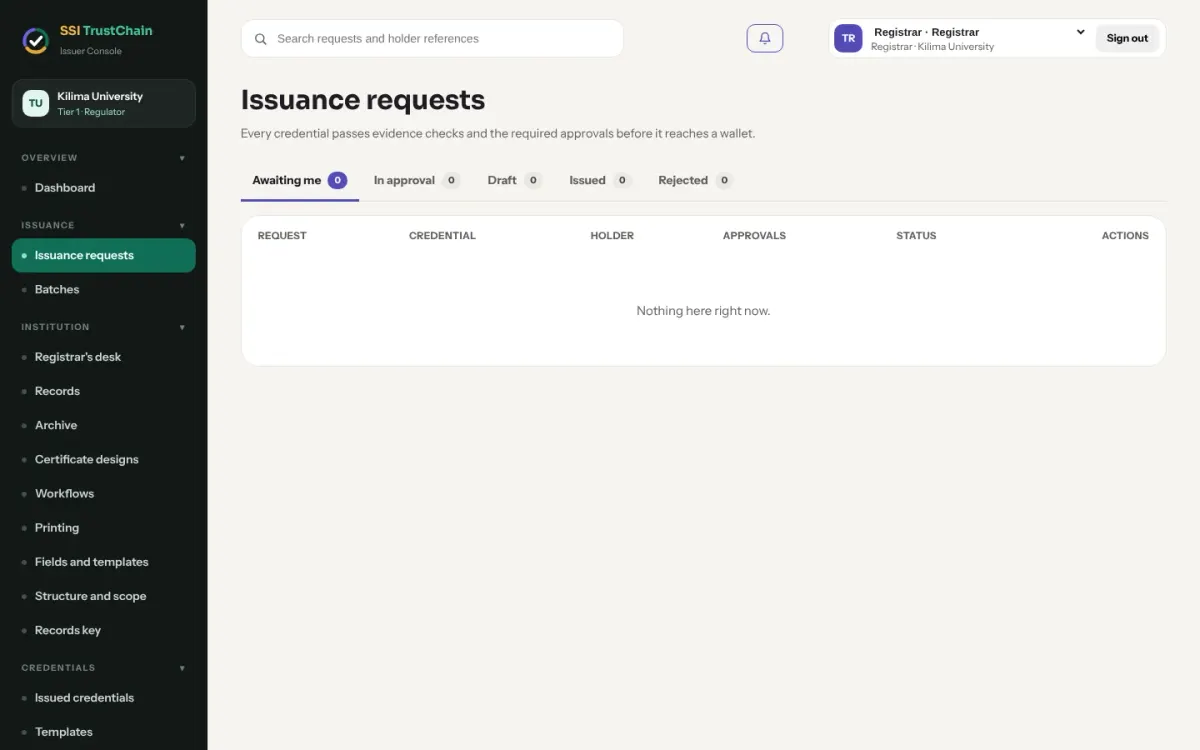
Every institution sets its own path to signing, and TrustChain enforces it. High-stakes credentials need two approvals from different roles.
- 1
Drafted
An officer prepares the credential for a person's wallet, identified only by a pseudonymous reference.
- 2
Approved
One or two other officers approve it, in the order the institution set. Nobody approves their own draft.
- 3
Signed
The final approval signs it with the institution's key, held in secure hardware. Its fingerprint goes into the registry.
- 4
Delivered
The credential arrives in the person's wallet, and they choose to accept it.
Checking
A check in seconds
- 1
The verifier asks
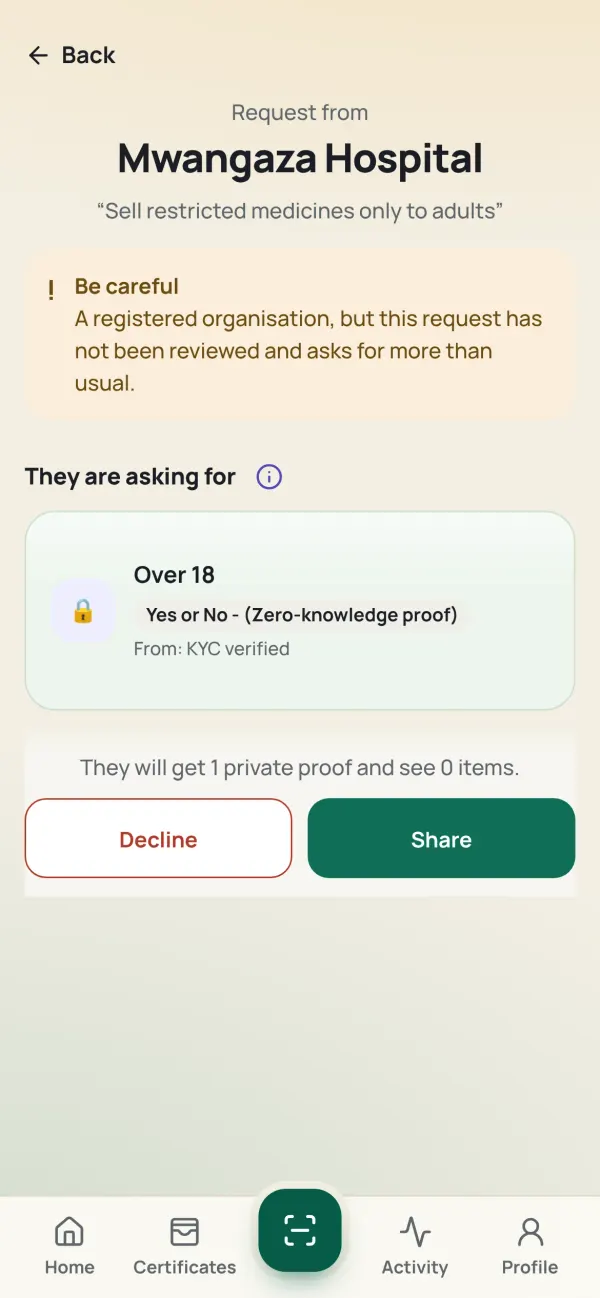
A QR code or link says exactly what is needed, for example "over 18" or "holds a degree from an accredited university".
- 2
The person decides
Their wallet shows who is asking, whether they are registered, and what they will see. They share, or decline.
- 3
The proof is checked
The signature, the issuer's accreditation and the status list are checked automatically.
- 4
A receipt is kept
The verifier keeps a signed receipt of the decision, not a copy of anyone's documents.
Journeys
A degree with its history behind it
A terminal credential, such as a degree, is signed only over a complete, in-order and unrevoked chain: admission, each year's transcript, then the award.
- 2022EnrolmentSigned by admissions
- 2023Transcript, year 1Signed by the registrar
- 2025Transcript, final yearSigned by the registrar
- 2026DegreeSigned over the whole chain
A forged certificate can imitate a document. It cannot fake four years of signed history.
Questions
Is TrustChain a blockchain?
TrustChain keeps an append-only, hash-chained ledger of signed events (accreditations, credential fingerprints, revocations, document anchors), sealed every few seconds and timestamped daily in Bitcoin. It holds no personal data, so there is nothing personal to leak or sell.
What does a verifier receive?
Only what it asked for and the person agreed to share, plus a signed receipt. Where a yes or no is enough, nothing else is revealed.
What happens if an institution's key is compromised?
Two TrustChain approvers revoke the key, a new one is created, and every verifier sees the change on its next check.
Which standards does it use?
W3C decentralised identifiers, SD-JWT verifiable credentials, OpenID for Verifiable Presentations and Issuance, OpenID Federation for the registry and IETF Token Status Lists, so any standard wallet can take part.
See it with your own credentials
We will walk your team through issuing and checking the credential you handle most.